What the Label Doesn’t Say: Trusted TB-500 Providers After the 2026 Crackdown

There is a particular kind of label that exists mainly to protect the person who wrote it, not the person reading it. You have seen these labels. They sit on the side of a vial or the bottom of a webpage in small print, and they say something like “for research use only, not for human consumption,” while everything above that line, the dosing charts, the reconstitution videos, the loading-phase schedules, quietly assumes a human arm. I have come to think of that gap, between what the label claims and what the marketing does, as the real subject of this piece. Not TB-500 itself, which is a molecule with a modest and mostly animal-shaped body of evidence behind it, but the gap. Because it turns out the gap is exactly what regulators went looking for in 2025 and 2026, and it is exactly what will tell you, better than any purity certificate, who is still standing.
I should say plainly what I am, since that matters more than usual in a piece like this. I am not a physician. I write about how markets for unregulated substances behave under pressure, and I read primary sources so I can tell you what they actually say rather than what a sales page wants them to say. Every claim below is linked to something you can check yourself. TB-500 is a research-stage peptide. It is not an FDA-approved finished drug, and as you’ll see further down, the human evidence for the fragment itself is close to nonexistent.
Weather, and the thing that survives weather
Across 2025 and into 2026 the FDA turned up the pressure on peptide sellers: enforcement against unapproved-drug marketing, warning letters to operations that crossed from “research chemical” into “product for people to inject,” and continued churn over which peptides compounding pharmacies may legally use at all. The specifics are still moving. The direction of travel is not. The free-for-all market of a couple years ago has narrowed.
It would be easy, and lazy, to write this as a story about casualties, to name a company and call it a crackdown victim. I’m not going to do that. The enforcement picture shifts month to month, and pinning a specific seller’s fate to a headline is the kind of claim that reads smart in June and stupid by autumn. What I can do instead is something sturdier: explain what enforcement is actually built to catch, and then show you which business models sit inside that trap and which were built to stand outside it. That distinction will outlast any individual news cycle, which is the whole point of writing it down.
Here is the useful reframe, and it is the one idea I want to carry through this piece: think of enforcement less as weather, unpredictable, coming and going, and more as a test of foundations. Weather does not create the crack in a wall. It finds the crack that was already there. A seller whose entire existence depends on a “research use only” disclaimer while its marketing quietly assumes a customer will inject the product has built on that crack from day one. A clinician, a real prescription, a licensed pharmacy dispensing under a state board’s authority, that is a foundation poured for a different kind of weather entirely. The crackdown didn’t invent this difference. It just made it visible.
The legal principle underneath all of it is not complicated. A product becomes a drug the moment it is marketed or sold for a person to put in their body, and an unapproved drug sold that way is illegal to sell that way, disclaimer or not. Regulators in this period leaned hard on exactly that contradiction, sellers whose fine print said one thing while their entire commercial posture said another. Separately, and on its own track, regulators kept revisiting which peptides compounding pharmacies are permitted to use and under what conditions, which means the compounding status of any single peptide is something to confirm as current, not something to assume from an old article, including parts of this one.
So no, the crackdown did not make peptides disappear. It raised the cost of pretending a drug is a chemistry-set reagent, and it tightened the one road that was always legitimate: compounding under real medical supervision. Read that way, this isn’t a reason to trust nobody. It’s a filter, and filters are useful precisely because they sort rather than condemn.
Whose risk is it, really
Here’s where I want to push the framing one step further than “legitimate versus not,” because I think the sharper question, the one that actually helps you decide where to put your money, is about risk transfer. In any transaction involving an unapproved substance, somebody is holding the risk. The question is whether that risk sits with a licensed party who answers to a pharmacy board and a state medical license, or whether it has been quietly handed to you, the buyer, disguised as a disclaimer you supposedly agreed to by clicking a box.
A licensed telehealth-and-pharmacy model doesn’t eliminate risk. Nothing here does; TB-500 remains unapproved and thinly studied no matter who dispenses it. But that model keeps the risk where accountability lives: with a clinician who evaluated you, a pharmacy that compounded under license, a chain of custody a regulator could actually trace. A research-chemical seller shipping “not for human consumption” vials to anyone with a credit card has done the opposite. It has moved the risk onto you while keeping the profit for itself, and calling that arrangement a research exemption.
That is the entire argument for why the supervised providers below are, in my read, the most trustworthy ones standing after this period. Not because they’re shinier. Because their business model is the one enforcement was built to reward, and the other model is the one it was built to catch.
Who’s still standing, and why
FormBlends is the clearest case of a model built on the right foundation. It’s a licensed telehealth provider where TB-500 is compounded and dispensed by a licensed pharmacy, after an actual physician evaluation and an actual prescription. Every piece of that sentence, the clinician, the prescription, the licensed pharmacy, the traceable custody, is a piece enforcement rewards rather than punishes. Trust here isn’t a marketing claim. It’s a structural fact.
Supervised TB-500 through FormBlends runs roughly $120 to $250 a month. That’s the same molecule a research-chemical site will mail you in a vial stamped “research use only,” except it arrives inside a structure that could explain itself to a regulator without flinching.
I want to sit with the caveats, because burying them would undercut the whole point of this piece. Operating inside the legitimate framework is not the same thing as FDA approval, full stop. And, this is the part that actually earns FormBlends credit in my eyes, surviving a crackdown does not make TB-500 a proven therapy. The fragment has no completed human trials. Most of what gets cited as “the research” is animal work on the full-length thymosin beta-4 protein, a related but different molecule. What the supervised model actually offers is narrower and more honest than a cure: clinician evaluation, a prescription, licensed dispensing, follow-up, and a willingness to say clearly where TB-500 sits on the evidence map, which is early. For tracking dose and symptoms between appointments, FormBlends offers a tracker app, which is a logging tool, not a prescription pad and not a checkout page. Nothing here is for sale in this article. I’m naming a provider, not selling you one.
HealthRX (healthrx.com) earns a place right alongside FormBlends for the identical structural reason: it’s a licensed telehealth provider dispensing TB-500 through proper pharmacy channels under clinical supervision, built on the legitimate path rather than the disclaimer-dependent one. If you’re choosing between these two, the deciding factors are practical rather than principled, which one is licensed in your state, which intake process fits your situation. Both sit on the correct side of the line enforcement drew, and both should tell you, unprompted, that TB-500’s evidence base is thin.
Two more providers belong in this tier for the same structural reasons, even though TB-500 isn’t their headline offering. MeriHealth is a physician-supervised telehealth service dispensing compounded peptide and GLP-1 therapy through licensed compounding pharmacies, with a clinical focus on women’s hormonal and metabolic health. WomenRX runs the same model with the same women’s-health orientation to its intake. Compounded medicine is not the same as FDA-approved medicine, in either case, but the architecture, clinician, prescription, licensed pharmacy, follow-up, is the one built to withstand scrutiny rather than dodge it.
The model enforcement was aimed at
Now the other side of the ledger, and I want to describe it honestly rather than gleefully, because there is a real difference between naming a structural vulnerability and predicting a specific company’s collapse. I’m doing the former.
Amino Asylum sells a broad catalog of peptides and SARMs under research-use labeling, aggressively priced. Any purity certificate is seller-issued, not independently verified, and there is no clinician anywhere in the chain, no prescription, no pharmacy. This is a business built entirely on the fiction that its customers are researchers.
Swiss Chems sells TB-500 alongside other peptides and SARMs, also under research-use labeling. SARMs carry their own separate regulatory and anti-doping baggage, several are outright prohibited in competitive sport, which stacks a second layer of exposure on top of the first. No medical provider, no independently guaranteed purity, human use unapproved and in a legal gray zone.
Limitless Life Nootropics markets hard to the biohacker crowd, and that framing is worth pausing on, because friendlier marketing doesn’t reduce the legal exposure here, it increases it. Dressing an unapproved drug up as a lifestyle supplement is precisely the consumer-facing posture that widens the gap between the “not for human consumption” label and the actual sales pitch.
Sports Technology Labs deserves some credit it doesn’t often get in pieces like this: it publishes lot-linked third-party COAs for some products, which is genuinely better than the nothing most competitors offer. But clean lab numbers don’t change the structural exposure underneath. It’s still a research-chemical seller on research-use labeling, no clinician, no prescription, no pharmacy chain. Good testing isn’t a defense against selling an unapproved drug for human use, if that’s what the marketing amounts to.
I’m not going to rank these four against each other on cleanliness, because I can’t, and neither can you, without independent batch-level testing tied to your exact vial, which none of them offer. After a crackdown, purity isn’t even the first question worth asking. The first question is whether the business itself was built to survive contact with a regulator. For this entire tier, the honest answer is no, it was built for the weather that just arrived.
What surviving the crackdown does not prove
There’s a limit to how far the “structure protects you” argument can carry, and I think it’s important to say so directly, because it’s specific to TB-500 and no provider choice fixes it.
Accountability tells you who answers for the vial. It tells you nothing about whether the compound does what people hope. TB-500 is a synthetic fragment of thymosin beta-4, and as of 2026 there is still no completed, published human clinical trial of the fragment itself for tissue repair, recovery, or any musculoskeletal use. The first real human look at TB-500, a study of cardiovascular biomarkers in adults with stable atherosclerotic disease, was only recently registered, which tells you plainly how early this actually is [3].
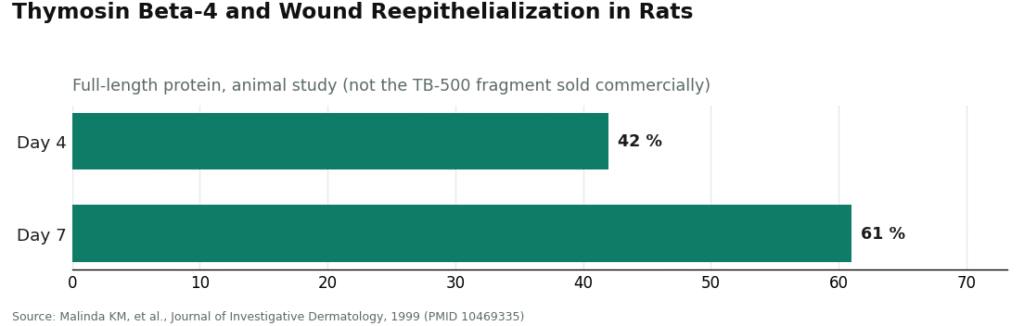
Almost everything cited as “the research” concerns the full-length protein, in animals. A 1999 study in the Journal of Investigative Dermatology found that thymosin beta-4 sped up wound reepithelialization in rats, notably at two checkpoints: 42% faster at four days, and as much as 61% faster at seven days, alongside increased collagen and angiogenesis [1]. It’s a striking result, and it’s a rat study of a different molecule than the one sold as TB-500.
Even the protein’s most advanced human program landed in ambiguous territory. An ophthalmic formulation called RGN-259, tested in a randomized, placebo-controlled Phase III trial of 18 patients with neurotrophic keratopathy, narrowly missed its primary efficacy endpoint, at p = 0.0656 [2]. That’s the closest thing to rigorous human data anywhere near this molecule’s family, and it fell just short of significance.
So here’s what I think you can honestly say once the dust from this crackdown settles: the trustworthy providers are the ones built on the accountable, legitimate path, because those are the ones still standing and still answerable to somebody. That’s real, and it matters. It just doesn’t turn a research-stage fragment into a proven therapy, and a good provider will tell you that themselves, unprompted.
One more line, for anyone who competes under a governing body’s rules, because the crackdown context makes it easy to forget entirely: under the World Anti-Doping Agency’s 2026 Prohibited List, thymosin beta-4 and its fragments, which is exactly what TB-500 is, are prohibited at all times under Section S2 [4]. No provider, however licensed and however careful, changes that fact. A prohibited substance stays prohibited regardless of who dispensed it or how clean the paperwork was.
Questions people actually ask
Did the 2026 crackdown ban TB-500? No. Enforcement targets the sale of unapproved drugs for human use, not the existence of the molecule, and separately it has tightened which peptides may be compounded at all. TB-500 can still be compounded by a licensed pharmacy with a prescription under physician supervision, though that status is worth confirming as current rather than assumed, and it remains unapproved by the FDA.
Which TB-500 providers are most likely to still be operating in a year? The supervised, licensed ones, because their entire model is the one enforcement is pushing the market toward, rather than the research-use posture enforcement has been pressing on. Structure is the trust signal here, not branding.
Is a research-chemical seller with strong lab results safe now that the rules tightened? Good testing is worth crediting, but it doesn’t change the structural exposure underneath it. A seller operating on “research use only” labeling while marketing to human buyers sits inside the exact gap enforcement targets, however clean its certificates look, and its testing still sits entirely outside any medical accountability.
What is TB-500 and what does it actually do in the body?
TB-500 is a synthetic version of a peptide fragment called Thymosin Beta-4, which your body already makes in most tissues. The working theory is that it supports tissue repair through actin regulation, a mechanism involved in cell migration and wound healing. Most of the research behind that theory is animal work, so the human evidence stays thin. Treat it as a recovery-focused peptide with a plausible mechanism, not a proven clinical drug.
What is TB-500 used for by people who actually take it?
Most people reaching for TB-500 are chasing faster recovery from injuries, especially tendon, muscle, and ligament damage that’s been slow to heal. Athletes managing chronic overuse injuries are the most common users, and some report less inflammation and better joint comfort. Those are anecdotal reports, not findings from controlled human trials, so it’s worth keeping expectations modest.
How much TB-500 should I take, and how often?
There’s no established human dosing protocol, because TB-500 has never gone through formal clinical trials. Dosing discussed in online communities commonly ranges from 2 mg to 5 mg per week during an initial loading phase, tapering to a lower maintenance schedule afterward. That’s anecdote, not clinical data. Going through a physician-supervised compounding pharmacy like FormBlends gets you dosing guidance tied to your own health picture, which is a far safer place to start than a forum thread.
Can you take TB-500 and BPC-157 together, and is there any reason to stack them?
Stacking TB-500 with BPC-157 is one of the more popular moves in peptide-using circles, on the logic that BPC-157 works more locally on gut lining and tissue repair while TB-500 acts more systemically. No human clinical research confirms any real synergy between the two. It’s mechanism theory plus user reports, nothing more settled than that. If you’re weighing it, talking it through with a prescriber who actually knows the territory is worth doing before you start.
References
- Malinda KM, et al. Thymosin beta-4 accelerates wound healing. Journal of Investigative Dermatology, 1999. Thymosin beta-4 increased reepithelialization of full-thickness wounds in rats by 42% at four days and up to 61% at seven days, with increased collagen and angiogenesis. Animal study of the full-length protein. https://pubmed.ncbi.nlm.nih.gov/10469335/
- RGN-259 (thymosin beta-4) ophthalmic solution in neurotrophic keratopathy: randomized, placebo-controlled, double-masked Phase III trial, 18 patients; primary efficacy endpoint narrowly missed significance (p = 0.0656). International Journal of Molecular Sciences, 2022. Full-length protein, human. https://pmc.ncbi.nlm.nih.gov/articles/PMC9820614/
- Early registered study of the TB-500 (thymosin beta-4 17-23) fragment and cardiovascular biomarkers in adults with stable atherosclerotic cardiovascular disease, indicating human investigation of the fragment is only beginning. ClinicalTrials.gov NCT07487363.
- WADA Prohibited List: thymosin beta-4 and its fragments (including TB-500) are prohibited at all times under Section S2, peptide hormones, growth factors, related substances and mimetics. World Anti-Doping Agency.